Sunday, June 15, 2025

The Dangers of the Archetype of the Apocalypse

Throughout history, the human psyche has been haunted by the idea of total annihilation. Whether told through ancient myth, religious prophecy, dystopian fiction, or doomsday predictions, the Apocalypse has remained a persistent archetype -- a deeply embedded pattern in the collective unconscious that signifies not just the end of the world, but a profound transformation. While this archetype can sometimes catalyze renewal, its unchecked presence in modern culture and psychology poses serious risks. Understanding and confronting the dangers of the archetype of the Apocalypse is essential for both personal mental health and global societal stability.
 
Understanding the Archetype
 
The term "archetype" originates from Carl Jung's analytical psychology and refers to universal symbols or motifs that recur across cultures and time. The Apocalypse archetype is not merely about literal destruction; it represents a deep psychological confrontation with chaos, death, and radical change. Often, it includes imagery of fire, flood, war, or cosmic upheaval, tied to the annihilation of a current state of being and the emergence of something entirely new--or nothing at all.
 
In mythology, we see it in stories like Ragnarok in Norse lore or the Book of Revelation in Christianity. In modern culture, it's present in films like Mad Max, The Matrix, or Children of Men, and in conspiracy-laden movements that predict economic, spiritual, or environmental collapse.
 
But why is this archetype so dangerous?
 
1. Psychic Inflation and Collective Delusion
 
One of the most potent dangers is the psychological phenomenon of psychic inflation, where individuals or groups become so gripped by apocalyptic thinking that they identify with cosmic-level significance. Jung warned that individuals who fall under the sway of powerful archetypes can lose their sense of proportion, leading to delusions of grandeur, righteousness, or catastrophe.
 
In this state, people may begin to interpret normal events as signs of impending doom. Every economic downturn, climate shift, or technological advancement becomes a harbinger of collapse. This mindset not only breeds fear but also justifies extreme behavior: survivalism, cult-like group dynamics, or acts of violence "in preparation" for the end.
 
When enough people fall into this mode of thought, collective delusion becomes possible. Mass hysteria, cult movements, and radical ideologies can thrive--fueled by the belief that destruction is not just imminent but necessary.
 
2. Despair and Fatalism
 
Another danger of the apocalyptic archetype is psychological paralysis. If you believe the world is beyond saving, why try to fix it? Climate change becomes an unsolvable fate. Political corruption seems unstoppable. Social decay feels irreversible.
 
This kind of fatalism erodes the will to act. It fosters apathy, depression, and even suicidal ideation. Many young people today express eco-anxiety or "doomer" worldviews because they've internalized apocalyptic narratives as unshakable truths. The danger lies in confusing an archetypal drama with empirical reality.
 
The result? A loss of hope, engagement, and the ability to imagine positive futures.
 
3. Radicalization and Extremism
 
Apocalyptic thinking has historically been a powerful tool for radicalization. Extremist movements across the ideological spectrum--from religious fundamentalists to political revolutionaries--often use end-times narratives to justify violence. When a group sees itself as fighting against cosmic evil or preparing for divine judgment, ordinary moral boundaries are easily dismissed.
 
Terrorist organizations, cults like Heaven's Gate, and even certain political factions have all used apocalyptic logic to commit atrocities. The belief that "the end is near" transforms complex realities into black-and-white dualisms of good vs. evil, us vs. them.
 
In this environment, critical thinking collapses. The archetype becomes not just a story, but a script for violent action.
 
4. Cultural Escapism and Fantasy Addiction
 
In a more subtle but no less damaging form, the apocalyptic archetype fuels escapism. In books, games, and films, dystopias and post-apocalyptic worlds offer a sense of gritty heroism, simple moral clarity, and release from the mundane frustrations of real life.
 
While such stories can be cathartic or cautionary, overexposure breeds detachment. Instead of engaging with the messy complexity of real-world issues, some retreat into fantasy--believing deep down that everything must fall apart before it can get better.
 
This mindset can be particularly dangerous when combined with technological determinism. For example, the idea that artificial intelligence will either save or destroy us can paralyze rational discourse about how to actually govern it. By framing issues in apocalyptic terms, we avoid the real work of incremental change.
 
5. Suppressing the Feminine and Rebirth Archetypes
 
The Apocalypse is often a masculine archetype: fiery, destructive, righteous. It destroys the old but does not always make space for what comes next. By focusing obsessively on death, we risk suppressing the equally vital feminine archetypes of regeneration, healing, and nurturing.
 
Cultures caught in apocalyptic thinking often show diminished interest in sustainability, empathy, and cooperation. These "softer" virtues are dismissed as irrelevant in the face of total war or collapse.
 
But psychologically, integration demands balance. Destruction without rebirth is nihilism. Chaos without order is madness. The danger of the apocalyptic archetype is that it often refuses to yield to the more nuanced, hopeful energies that follow true transformation.
 
Moving Beyond the Apocalypse
 
So, how can we protect ourselves from being consumed by this archetype?
  • Discern Symbol from Reality: Recognize when apocalyptic narratives are being used to dramatize real concerns (e.g., climate change, AI ethics) and consciously choose to stay grounded in facts.
  • Balance with Creative Archetypes: Re-engage with stories of rebirth, healing, and community. Seek out narratives that offer hope, not just warnings.
  • Cultivate Psychological Resilience: Practices like therapy, mindfulness, and journaling can help us process fear and despair without projecting it onto the world.
  • Challenge Extremism: Politically and socially, we must resist hose who weaponize apocalyptic thinking for power. This means supporting education, civil discourse, and democratic resilience.
  • Imagine Better Futures: Apocalyptic thinking thrives in the absence of vision. If we want to defuse it, we need to imagine--and work toward--radically better worlds.
Conclusion
 
The archetype of the Apocalypse is deeply embedded in human consciousness, and in small doses, it can be a wake-up call. But when it dominates our inner or outer landscapes, it becomes toxic--fueling despair, radicalization, escapism, and paralysis. From my perspective, the archetype of the Apocalypse is manifesting itself in our physical reality now. Rather than surrender to its destructive grip, we must confront it with awareness, compassion, and imagination. The world may be in crisis, but it is not yet ending. And even if it were, the more vital question remains: what might be born from the ashes?

Sunday, June 8, 2025

FeedSpot Top 10 Shamanism Blogs

Feedspot is an online RSS feed reader that allows users to consolidate their favorite blogs, podcasts, news websites, YouTube channels, and RSS feeds into one convenient platform. It essentially acts as a centralized hub for staying up-to-date with various online content sources, eliminating the need to visit each website individually. FeedSpot lets you subscribe to your favorite Blogs, Podcasts, News Websites, Magazines, YouTubers, Influencers and RSS feeds in one place on FeedSpot Reader. FeedSpot organizes the world's best Blogs, Podcasts, Youtubers, and Influencers in relevant categories and publishes a top-ranked list for each of those categories. According to FeedSpot, these are the top 10 Shamanism Blogs you should follow in 2025:

1. Aziz Shamanism: I am Peter Aziz, a healer, magician, and shaman living in Devon, UK. I have spent my whole life training in shamanism, healing, yoga, magick, and metaphysics, and learning from the faery kingdom. I have dedicated myself to bringing the ancient wisdom to the public, to help all spiritual seekers to further themselves.

2. Shamanic Drumming: The Internet's only blog devoted to news and commentary related to shamanic drumming, music and arts. Michael Drake launched this site in 2010 in order to share the healing power of rhythm with like-minded members of our global shamanic community. His mission is to create a vibrant international community devoted to shamanic drumming as a vehicle for healing, consciousness expansion and community building. 

3. The Wired Shaman: Explore the many benefits and treatment types of Shamanic Healing. Read about the experiences of others who have benefited from Shamamisn. Learn more about healing methods from the Wired Shaman.

4. Sharon Ramel Shamanic Blog: Our mission is to offer transformative spiritual shamanic courses online to help you discover your unique pathway to support your personal learning pathway.
https://sharonramel.com/shamanic-blog/

5. Shamanic Journey: Trained as a computer scientist, my rational approach never prevented me from keeping an open mind and being interested in many spiritual traditions. This desire to progress, to improve, to explore, finally brought me to Peru, to meet the shamans of the Amazon. For more than ten years now, I have regularly returned to Peru to continue my initiation with shamans, with the intention of bringing back a part of this ancestral wisdom, in order to share it and to benefit those who wish to explore this magnificent medicine.
 
6. Indie Shaman: Indie Shaman aims to do provide a supportive network for those interested in shamanism or a shamanic way of life, as well as for Shaman and Shamanic Practitioners from all cultures and for those of mixed heritage as well as those who are unsure yet as to where their cultural heritage lies. In doing this we aim to provide a means of helping people answer questions about life, promote self-discovery and self-development and encourage respect for the self, the community and the land.

7. Shaman Durek: Shaman Durek is a 6th generation shaman, and author of the best seller, 'Spirit Hacking: Shamanic Keys to Reclaim Your Personal Power, Transform Yourself, and Light Up the World.' Read Shaman Durek's blog where he shares valuable shamanic wisdom.

8. Reiki Shamanic Healing: I'm Alessandro Ferrari, a Shamanic Reiki Practitioner. I work with the powerful healing energy of Reiki combined with the ancient shamanic practices of South America. I can help you through the connection with the sacred spirits of Rape and Sananga, and with the powerful knowledge of Amazonian Forest Oracles.

9. Therapeutic Shamanism: A regular blog exploring the links between shamanism, animism, counseling and psychotherapy, ecology, and much more. 

10. Shamanic Spirit Medicine: Our Vision is that our Work to Contributes Positively to the Healing and Preservation of the Web of Life. Shamanism is a Gift for All People, a gift for everyone who wishes to use this Medicine in Right Relationship with the Intention of making a Positive Contribution to the Healing & Preservation of the Web of Life.

Sunday, June 1, 2025

Living with Chaos: Navigating Uncertain Times

In a world that feels increasingly fast-paced, disordered, and uncertain, many of us find ourselves grappling with chaos--externally in the form of world events, career upheavals, or personal relationships, and internally in the shape of anxiety, stress, or emotional turbulence. While our instinct may be to resist it, suppress it, or desperately try to restore order, the truth is that chaos is an inescapable part of life. Rather than fighting it, what if we learned to live with it--maybe even thrive within it?
 
The Illusion of Control
 
From a young age, we're taught to plan ahead, make schedules, set goals, and expect a kind of linear progression through life. But life rarely moves in straight lines. Unexpected detours--both welcome and unwelcome--arise constantly. The job you thought you'd stay in for years disappears overnight. A relationship you believed was solid ends suddenly. A global pandemic shuts down the world. Despite our best efforts, we are often reminded that control is more illusion than reality.
 
This illusion of control can create significant psychological strain when things don't go as expected. We feel as though we've failed, or worse, that we're powerless. But living with chaos doesn't mean embracing powerlessness. It means reframing our relationship with uncertainty.
 
Chaos as Catalyst
 
Though it may sound counterintuitive, chaos often acts as a catalyst for growth. It pushes us out of our comfort zones, challenges our assumptions, and forces us to adapt in ways we never imagined. Innovation, creativity, and transformation often emerge not during periods of calm but in the midst of disruption.
 
Think of the artists who create their most powerful work after loss, or entrepreneurs who build game-changing companies after setbacks. Chaos can clear the ground, stripping away what is no longer serving us and making space for something new. It asks us to look inward and re-evaluate who we are, what we value, and where we want to go.
 
Learning to Navigate
 
Living with chaos doesn't mean resigning ourselves to a life of disorder and overwhelm. It means developing tools, habits, and mindsets that help us remain steady--even when everything around us is shifting.
 
Here are 10 ways to build resilience in the face of chaos:
 
1. Anchor Yourself with Routine: Amidst external disorder, internal order can be a life raft. Creating small, meaningful routines--whether it's a morning coffee ritual, a daily walk, or a journaling habit--can provide stability. These acts become anchors that remind us of our agency and help us ground ourselves when everything else feels fluid.
 
2. Embrace Flexibility Over Rigidity: Plans are helpful, but clinging to them too tightly can set us up for disappointment. Instead, cultivate adaptability. Learn to pivot when needed. Flexibility doesn't mean you lack direction--it means you're resilient enough to adjust your course without losing your sense of purpose.
 
3. Mindfulness and Presence: One of the most effective ways to handle chaos is by focusing on the present moment. Mindfulness trains us to observe our thoughts and surroundings without judgment. It helps reduce anxiety, which often stems from trying to control the future or regretting the past. In chaos, mindfulness helps us stay centered and grounded. When we center ourselves and calm our minds, we stop feeding the negative drama that is playing out on Earth.
 
4. Reframe the Narrative: The story we tell ourselves about chaos matters. Is it something happening to us--or for us? Are we victims of it, or students of it? When we shift the narrative, we can begin to see disruption not as something to fear but as a teacher that challenges us to grow.
 
5. Seek Connection: Isolation often amplifies the weight of disorder. Chaos feels more manageable when shared. Whether through friends, family, support groups, or therapists, connecting with others provides perspective, emotional support, and shared resilience. You don't have to carry it all alone.
 
6. Broaden Your Perspective: When we become fixated on the chaos, violence and cruelties taking place in the world, we lose perspective. We must take the long view if we are going to truly see. Any time we set out to change our lives or the world, we have to take the long view.
 
7. Prioritize Ruthlessly: Not everything is equally important. Learn to identify what truly matters and let the rest go.
 
8. Limit Input: In chaotic times, information overload can be paralyzing. Be selective about the news you consume and the voices you listen to.
 
9. Set Boundaries: Protect your energy. Say no when needed and recognize that doing everything is not a sign of strength.
 
10. Develop a spiritual practice: A spiritual practice is something you do every single day that facilitates deeper self-awareness, empathy and connectedness with others. A spiritual activity might be dancing, drumming, chanting, meditating, praying, doing yoga or tai chi. Regular spiritual practice fosters inner peace, insight, compassion, non-attachment, integration and a sense of unity.
 
The Role of Creativity in Chaos
 
Interestingly, creativity and chaos are close companions. Great art, groundbreaking ideas, and transformative solutions often come from those willing to venture into the unknown. Chaos is fertile ground for imagination because it breaks the mold. When everything is predictable, there's little incentive to imagine differently. But in chaos, we are invited to think outside the box, question assumptions, and create anew.
 
If you're facing a chaotic period in your life, consider channeling your energy into something creative. Write. Paint. Build. Invent. Even if the results don't lead to a masterpiece, the act of creating can offer a sense of purpose and release amid uncertainty.
 
Chaos Is Not the Enemy
 
Perhaps the greatest lesson in living with chaos is recognizing that it is not the enemy. In fact, without chaos, life would be dull, predictable, and static. Growth requires disruption. Change demands upheaval. The key is not to eliminate chaos but to learn how to dance with it.
 
Ancient philosophies understood this well. In Taoism, the concept of yin and yang teaches that order and chaos are not opposing forces but complementary ones. In Hindu mythology, the god Shiva represents both destruction and creation. Even in science, chaos theory acknowledges the underlying patterns within seeming randomness. Nature itself thrives on cycles of disorder and rebirth.
 
From a shamanic perspective, chaos is not simply disorder but a dynamic, fertile ground where new possibilities and wisdom can emerge. It's viewed as an integral part of the universe, a source of both power and transformation. Shamanic practices often involve working with and navigating the chaos, seeking guidance and understanding from spirits and deities within the chaotic realm.
 
Becoming Chaos-Literate
 
Living with chaos means becoming chaos-literate--learning its rhythms, accepting its presence, and building a life that isn't destroyed by it but strengthened through it. It's about knowing that life will never be entirely predictable, and that's not a flaw to fix--it's a feature to embrace. If you're in a chaotic season right now, take heart. You are not alone. This too will pass, but in the meantime, there is wisdom, beauty, and unexpected strength to be found in the storm. The chaos may not calm down tomorrow, but you can become calmer within it. And that's more powerful than trying to control the uncontrollable.

Sunday, May 25, 2025

What are Spirit Helpers?

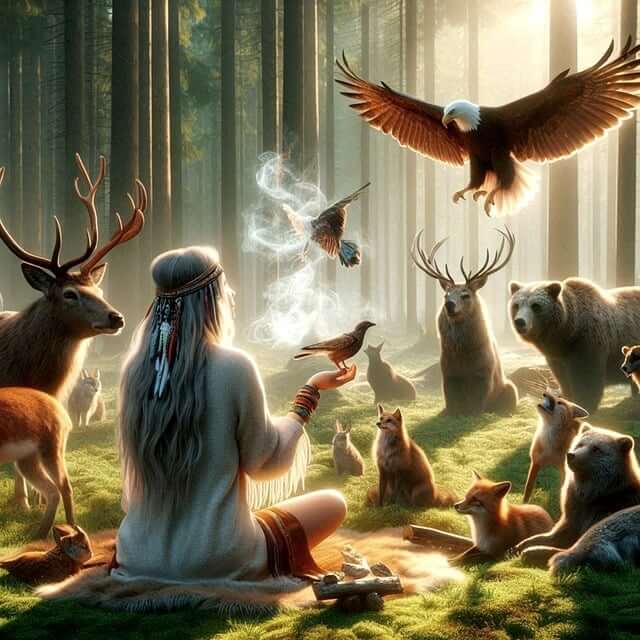
Shamanism is the intentional effort to acquire and nurture ongoing relationships with personal helping spirits by journeying into realms where the spirits dwell. These helping spirits might be the spirits of nature, animals, plants, the elements, ancestors, gods, goddesses, or teachers from various religious traditions. The reason for developing intimate relationships with spirit helpers is to gain wisdom, healing techniques, and other vital information that can benefit the community. In shamanic healing, it is the spirit helpers who do much of the actual healing work. In some ways, it might be more accurate to call the shaman the spirit's helper rather than vice-versa.

Whether you realize it or not, you have always had helping spirits. Helping spirits are like family and friends, and each has a unique personality. Basically, a spirit helper is a coherent energy pattern that may take form as an animal, plant, ancestor, deity, element, or even a mythical creature such as a unicorn or dragon.

Mythical creatures manifest in our conscious, mythic awareness because they still exist in the Lower World. The same holds true for creatures that lived in the past and that are now extinct. A group archetype or oversoul of each extinct species continues to exist in the Lower World, so a person may have a dinosaur or mammoth as a power animal.

All helping spirits are extensions of the "one spirit" that pervades all existence, whom we could call God, the Tao, or Great Mystery. Spirits are a natural manifestation of human consciousness. They manifest in two main categories: those who have physical form and those who do not or no longer do. Those helping spirits that have a physical form are known as elementals and may include representatives of the plant, animal, or mineral kingdoms, or an element such as air, water, fire, earth, sun, moon, planets, stars, and so on.

Spirit helpers that do not operate out of the physical realm may include ancestors who choose to be of service to us or divine archetypes such as angels and devas. In the cultures of the past, these typically were the gods and goddesses of the Upper World. These helping spirits can take on a human form temporarily and act as intermediaries between us and the powers of the universe. They may include great spiritual teachers such as Jesus, Buddha, Lao-Tzu, and so on.

Trees and plants also manifest as helping spirits. Plant spirits are one of the major allies of shamans for healing, seeing, dreaming, and empowerment. Shamans heal using their knowledge of plant spirits as well as the plant's medicinal properties. When the shaman does not know what plant medicine to use for a sick person, the spirit of the plant tells him. 
 
Plants, however, are more than their chemical components. They are intelligent beings that have the capacity to raise consciousness to a level where true healing can take place. Plants have always evolved before their animal counterparts and offer profound guidance regarding our own spiritual evolution.

Power Animals

The majority of helping spirits take animal forms called power animals. Power animals are also called guardian spirits, spirit allies, totem animals, and tutelary animals. A power animal is the archetypal oversoul that represents the entire species of that animal. It is actually the spirit of one of the First People, as they are called, who at the end of mythic times turned into the animals as we know them today.

The mythology and creation stories of all Earth peoples speak of a primordial, but now lost paradise--a Garden of Eden in which humanity lived in harmony with all that existed. The cosmos had total access to itself. There was but one language for all creatures and elements. Humans were able to converse with animals, birds, minerals, and all living things. 
 
As respected Nakoda elder John Snow puts it, "We talked to the rocks, the streams, the trees, the plants, the herbs, and all nature's creations. We called the animals our brothers. They understood our language; we understood theirs. Sometimes they talked to us in dreams and visions. At times they revealed important events or visited us on our vision quests to the mountain tops."

Animal characters played a prominent role in mythology. They were often portrayed as essentially human in bodily makeup, but possessed the individual characteristics of animals as they exist in nature today. Thus, Coyote is distinguished in the tellings by its mischievous behavior and Eagle by its great vision and ability to fly high into the sky realm of the Creator. Then, according to various cultural myths, the animals evolved into the forms in which they are found today. Raven, for example, is embodied in each individual member of the raven species, but Raven himself still lives in mythic times.

In the worldview of the shaman, power animals or animal archetypes such as Eagle, Coyote, and Bear represent and protect their entire species. When you connect with a power animal, you align yourself with the collective strength and wisdom of the entire species. One of the most important gifts that animal allies offer is protection and guardianship to the shaman during arduous shamanic tasks. Without this alliance, it is widely accepted that it is impossible to become a shaman.

Power animals are themselves great teachers and shamans. In many shamanic cultures, the knowledge imparted by a power animal is considered more important than the practical guidance of a master shaman. Power animals are valuable allies who can help you navigate through life's challenges and transitions. Many animals will come to guide you, some briefly and others throughout your life.

Power animals offer humans a much needed medicine. They remind us of what is innocent and truthful. Animals subsist from the heart, with a deep instinctual knowing that is always connected to the web of life. They live from the heart and are not entrapped by their reason. Humans, on the other hand, tend to live from the head, trying to figure everything out. But the energy that comes in from the source is directed through our hearts. We come into our own power when we learn to live from the heart. The heart attunes us to the flow of a dynamic, interrelated universe, helping us feel connected rather than isolated and estranged.
 
Building a Sacred Partnership

Shamanism is a sacred call to build relationship. A skillful shamanic practitioner works in sacred partnership with helping spirits--the power animals, the benevolent ancestors, and the sacred elements. Spirit helpers are the caretakers in the unseen world who want to support the earth and her inhabitants at this time. They are here to teach us how to gather wisdom from the spiritual realms, the natural world, the past, the present, and the future in order to give birth to new ways of being.

The shamanic relationship between humans and helping spirits supports our spirit's quest for self-realization. Helping spirits, if engaged regularly and skillfully, offer flexibility, creativity, and perseverance in fulfilling our own unique path. The spirits are here to teach us to be better humans. They come to assist us in doing the principal unique thing we have come here to do in a way that benefits all living things.

Sunday, May 18, 2025

The Time of the Black Jaguar

In the deep rainforests of the Amazon, among the sacred ruins of the Maya, and within the myths of indigenous cultures across the Americas, there is a recurring symbol: the jaguar. Elusive, powerful, and deeply revered, the jaguar is not just a predator--it is a guardian, a bridge between worlds, and a harbinger of transformation. Today, many spiritual thinkers, elders, and eco-activists refer to a new age dawning: The Time of the Black Jaguar.
 
This is not merely a poetic title. It is a profound invocation--a recognition that we are living in a moment of planetary shift, calling us to awaken ancient wisdom, honor the Earth, and face the darkness within and without. It is a time of fierce grace.
 
The Mythic Jaguar
 
For millennia, the jaguar has held an exalted place in the spiritual traditions of Mesoamerican and South American peoples. Among the Maya, the jaguar was associated with the underworld and night. It was a creature that could move between realms--life and death, day and night, seen and unseen. The Olmecs, some of the earliest inhabitants of Mesoamerica, carved massive stone heads that many believe depict jaguar-human hybrids, symbolizing shamanic transformation.
 
To the Inca, the jaguar (called otorongo) represented power and was one of the three sacred animals of their cosmology: the serpent (wisdom of the underworld), the puma (power of this world), and the condor (vision of the upper world). The Amazonian tribes still see the jaguar as a spiritual teacher--a totem of integrity, instinct, and inner sight.
 
But what does it mean when we say this is the Time of the Black Jaguar?
 
A Threshold Moment
 
The world is undeniably at a threshold. Climate collapse, biodiversity loss, mass migration, spiritual disconnection, and systemic inequality press in on all sides. Yet, alongside this, there is a rising tide of consciousness, activism, and reconnection to ancestral ways. More and more people are turning to indigenous knowledge systems, seeking healing through plant medicine, embracing holistic sustainability, and rediscovering the sacredness of life.
 
The Black Jaguar emerges as a symbol for this epoch--a time that requires us to move beyond conventional paradigms. The black jaguar, rarer and more mysterious than its golden kin, represents the hidden, the mystical, the shadow. It asks us to stop looking for salvation in the light alone, and instead, to find power in the darkness we've avoided: our collective traumas, our forgotten histories, our broken relationships with the Earth.
 
Embracing the Shadow
 
The Black Jaguar is not comfortable. It does not give easy answers. It demands that we face ourselves honestly. In Jungian psychology, the "shadow" is everything about ourselves we deny or repress. The Time of the Black Jaguar asks humanity to confront its shadow on a collective level.
 
Colonialism, industrial exploitation, racism, the commodification of nature--these are not aberrations, but consequences of a deeper rupture from the sacred. The jaguar calls us back to wholeness. That means reconciling with our past, acknowledging the wisdom of those we have silenced, and taking responsibility for the future.
 
This time is not about guilt or shame--it's about courage. Like the shamans who don jaguar pelts in ceremony, we are being asked to embody this courage: to move into the unknown, to protect what is sacred, and to lead with heart and instinct.
 
The Return of the Guardians
 
In many indigenous prophecies, there is a vision of a return--not just of balance, but of the Earth's guardians awakening once more. The Q'ero people of the Andes speak of the "Pachakuti," a turning of the world, where ancient knowledge resurfaces. The Hopi talk of the "Day of Purification," and the Kogi of Colombia refer to themselves as the "Elder Brothers," watching the younger (modern) brothers awaken at last to their role in the web of life.
 
In this context, the jaguar is more than an animal--it is a guardian spirit. The Black Jaguar, especially, is a signal that the time of forgetting is over. It is time to remember who we are: not owners of the Earth, but kin.
 
Jaguar Medicine
 
Jaguar represents shamanic power, magic, shapeshifting, transformation, and the life-and-death principle. She embodies the wisdom of the  underworld, the primal space of the unconscious deep within each of us. Jaguar's lesson is to move beyond your fear of the dark unknown. Jaguar is the epitome of a chaotic storm moving through your life, all the while demanding you to remain calm, centered, and grounded. This fierce animal is the gatekeeper to the unknowable. Jaguar medicine includes comprehending the patterns of chaos, walking without fear in the darkness, moving in unknown places, soul work, and reclaiming power. Invoke Jaguar to reclaim your true power. 
 
Rewilding the Soul
 
At the personal level, the Time of the Black Jaguar is an invitation to rewild the soul. Many of us live domesticated lives--scheduled, sanitized, separated from the natural world and from our own bodies. The jaguar does not tolerate domestication. It thrives in mystery, in instinct, in presence. To walk with the jaguar is to listen again to the Earth, to live from the gut, and to reclaim a deeper, more embodied way of being.
 
This does not mean retreating from the world. Rather, it means bringing our wild wisdom into our modern lives--choosing integrity over convenience, truth over comfort, presence over performance. It may take the form of activism, art, community healing, spiritual practice, or environmental stewardship. The outer form is secondary; what matters is the inner fire--the calling to live awake and aligned.
 
A Call to Protect the Sacred
 
Lastly, the Time of the Black Jaguar is a call to guardianship. As the jaguar protects its territory with silent watchfulness, we are being asked to protect what is sacred: the forests, the waters, the ancestral ways, the marginalized voices, the future generations.
 
This is not a romantic call to heroism--it is a sobering responsibility. It requires sacrifice, humility, and vision. It demands that we walk like the jaguar--silent when needed, fierce when provoked, always aware of the whole.
 
In a world obsessed with speed and spectacle, the jaguar teaches stillness and stealth. In a culture addicted to dominance, it teaches reverence. In a society lost in noise, it moves in mystery.
 
Becoming the Jaguar
 
We are living in mythic times, whether we acknowledge it or not. The Time of the Black Jaguar is not something to wait for--it is now. It is happening in the wildfires and the protests, in the deep soul yearnings, and in the quiet acts of reconnection. The jaguar walks among us, and within us. To embrace this time is to step beyond fear, into a deeper power. It is to reclaim the wisdom that lives in the land, in our bones, and in our dreams. It is to walk with grace, strength, and mystery. 
 
The Black Jaguar has awakened. Will you?