
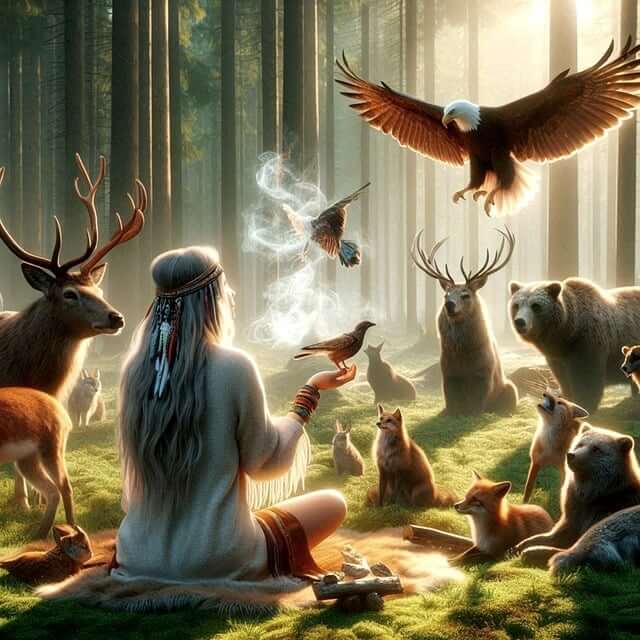
Shamanism is the intentional effort to acquire and nurture ongoing relationships with personal helping spirits by journeying into realms where the spirits dwell. These helping spirits might be the spirits of nature, animals, plants, the elements, ancestors, gods, goddesses, or teachers from various religious traditions. The reason for developing intimate relationships with spirit helpers is to gain wisdom, healing techniques, and other vital information that can benefit the community. In shamanic healing, it is the spirit helpers who do much of the actual healing work. In some ways, it might be more accurate to call the shaman the spirit's helper rather than vice-versa.
Whether you realize it or not, you have always had helping spirits. Helping spirits are like family and friends, and each has a unique personality. Basically, a spirit helper is a coherent energy pattern that may take form as an animal, plant, ancestor, deity, element, or even a mythical creature such as a unicorn or dragon.
Mythical creatures manifest in our conscious, mythic awareness because they still exist in the Lower World. The same holds true for creatures that lived in the past and that are now extinct. A group archetype or oversoul of each extinct species continues to exist in the Lower World, so a person may have a dinosaur or mammoth as a power animal.
All helping spirits are extensions of the "one spirit" that pervades all existence, whom we could call God, the Tao, or Great Mystery. Spirits are a natural manifestation of human consciousness. They manifest in two main categories: those who have physical form and those who do not or no longer do. Those helping spirits that have a physical form are known as elementals and may include representatives of the plant, animal, or mineral kingdoms, or an element such as air, water, fire, earth, sun, moon, planets, stars, and so on.
Spirit helpers that do not operate out of the physical realm may include ancestors who choose to be of service to us or divine archetypes such as angels and devas. In the cultures of the past, these typically were the gods and goddesses of the Upper World. These helping spirits can take on a human form temporarily and act as intermediaries between us and the powers of the universe. They may include great spiritual teachers such as Jesus, Buddha, Lao-Tzu, and so on.
Trees and plants also manifest as helping spirits. Plant spirits are one of the major allies of shamans for healing, seeing, dreaming, and empowerment. Shamans heal using their knowledge of plant spirits as well as the plant's medicinal properties. When the shaman does not know what plant medicine to use for a sick person, the spirit of the plant tells him.
Whether you realize it or not, you have always had helping spirits. Helping spirits are like family and friends, and each has a unique personality. Basically, a spirit helper is a coherent energy pattern that may take form as an animal, plant, ancestor, deity, element, or even a mythical creature such as a unicorn or dragon.
Mythical creatures manifest in our conscious, mythic awareness because they still exist in the Lower World. The same holds true for creatures that lived in the past and that are now extinct. A group archetype or oversoul of each extinct species continues to exist in the Lower World, so a person may have a dinosaur or mammoth as a power animal.
All helping spirits are extensions of the "one spirit" that pervades all existence, whom we could call God, the Tao, or Great Mystery. Spirits are a natural manifestation of human consciousness. They manifest in two main categories: those who have physical form and those who do not or no longer do. Those helping spirits that have a physical form are known as elementals and may include representatives of the plant, animal, or mineral kingdoms, or an element such as air, water, fire, earth, sun, moon, planets, stars, and so on.
Spirit helpers that do not operate out of the physical realm may include ancestors who choose to be of service to us or divine archetypes such as angels and devas. In the cultures of the past, these typically were the gods and goddesses of the Upper World. These helping spirits can take on a human form temporarily and act as intermediaries between us and the powers of the universe. They may include great spiritual teachers such as Jesus, Buddha, Lao-Tzu, and so on.
Trees and plants also manifest as helping spirits. Plant spirits are one of the major allies of shamans for healing, seeing, dreaming, and empowerment. Shamans heal using their knowledge of plant spirits as well as the plant's medicinal properties. When the shaman does not know what plant medicine to use for a sick person, the spirit of the plant tells him.
Plants, however, are more than their chemical components. They are intelligent beings that have the capacity to raise consciousness to a level where true healing can take place. Plants have always evolved before their animal counterparts and offer profound guidance regarding our own spiritual evolution.
Power Animals
The majority of helping spirits take animal forms called power animals. Power animals are also called guardian spirits, spirit allies, totem animals, and tutelary animals. A power animal is the archetypal oversoul that represents the entire species of that animal. It is actually the spirit of one of the First People, as they are called, who at the end of mythic times turned into the animals as we know them today.
The mythology and creation stories of all Earth peoples speak of a primordial, but now lost paradise--a Garden of Eden in which humanity lived in harmony with all that existed. The cosmos had total access to itself. There was but one language for all creatures and elements. Humans were able to converse with animals, birds, minerals, and all living things.
Power Animals
The majority of helping spirits take animal forms called power animals. Power animals are also called guardian spirits, spirit allies, totem animals, and tutelary animals. A power animal is the archetypal oversoul that represents the entire species of that animal. It is actually the spirit of one of the First People, as they are called, who at the end of mythic times turned into the animals as we know them today.
The mythology and creation stories of all Earth peoples speak of a primordial, but now lost paradise--a Garden of Eden in which humanity lived in harmony with all that existed. The cosmos had total access to itself. There was but one language for all creatures and elements. Humans were able to converse with animals, birds, minerals, and all living things.
As respected Nakoda elder John Snow puts it, "We talked to the rocks, the streams, the trees, the plants, the herbs, and all nature's creations. We called the animals our brothers. They understood our language; we understood theirs. Sometimes they talked to us in dreams and visions. At times they revealed important events or visited us on our vision quests to the mountain tops."
Animal characters played a prominent role in mythology. They were often portrayed as essentially human in bodily makeup, but possessed the individual characteristics of animals as they exist in nature today. Thus, Coyote is distinguished in the tellings by its mischievous behavior and Eagle by its great vision and ability to fly high into the sky realm of the Creator. Then, according to various cultural myths, the animals evolved into the forms in which they are found today. Raven, for example, is embodied in each individual member of the raven species, but Raven himself still lives in mythic times.
In the worldview of the shaman, power animals or animal archetypes such as Eagle, Coyote, and Bear represent and protect their entire species. When you connect with a power animal, you align yourself with the collective strength and wisdom of the entire species. One of the most important gifts that animal allies offer is protection and guardianship to the shaman during arduous shamanic tasks. Without this alliance, it is widely accepted that it is impossible to become a shaman.
Power animals are themselves great teachers and shamans. In many shamanic cultures, the knowledge imparted by a power animal is considered more important than the practical guidance of a master shaman. Power animals are valuable allies who can help you navigate through life's challenges and transitions. Many animals will come to guide you, some briefly and others throughout your life.
Power animals offer humans a much needed medicine. They remind us of what is innocent and truthful. Animals subsist from the heart, with a deep instinctual knowing that is always connected to the web of life. They live from the heart and are not entrapped by their reason. Humans, on the other hand, tend to live from the head, trying to figure everything out. But the energy that comes in from the source is directed through our hearts. We come into our own power when we learn to live from the heart. The heart attunes us to the flow of a dynamic, interrelated universe, helping us feel connected rather than isolated and estranged.
Animal characters played a prominent role in mythology. They were often portrayed as essentially human in bodily makeup, but possessed the individual characteristics of animals as they exist in nature today. Thus, Coyote is distinguished in the tellings by its mischievous behavior and Eagle by its great vision and ability to fly high into the sky realm of the Creator. Then, according to various cultural myths, the animals evolved into the forms in which they are found today. Raven, for example, is embodied in each individual member of the raven species, but Raven himself still lives in mythic times.
In the worldview of the shaman, power animals or animal archetypes such as Eagle, Coyote, and Bear represent and protect their entire species. When you connect with a power animal, you align yourself with the collective strength and wisdom of the entire species. One of the most important gifts that animal allies offer is protection and guardianship to the shaman during arduous shamanic tasks. Without this alliance, it is widely accepted that it is impossible to become a shaman.
Power animals are themselves great teachers and shamans. In many shamanic cultures, the knowledge imparted by a power animal is considered more important than the practical guidance of a master shaman. Power animals are valuable allies who can help you navigate through life's challenges and transitions. Many animals will come to guide you, some briefly and others throughout your life.
Power animals offer humans a much needed medicine. They remind us of what is innocent and truthful. Animals subsist from the heart, with a deep instinctual knowing that is always connected to the web of life. They live from the heart and are not entrapped by their reason. Humans, on the other hand, tend to live from the head, trying to figure everything out. But the energy that comes in from the source is directed through our hearts. We come into our own power when we learn to live from the heart. The heart attunes us to the flow of a dynamic, interrelated universe, helping us feel connected rather than isolated and estranged.
Building a Sacred Partnership
Shamanism is a sacred call to build relationship. A skillful shamanic practitioner works in sacred partnership with helping spirits--the power animals, the benevolent ancestors, and the sacred elements. Spirit helpers are the caretakers in the unseen world who want to support the earth and her inhabitants at this time. They are here to teach us how to gather wisdom from the spiritual realms, the natural world, the past, the present, and the future in order to give birth to new ways of being.
The shamanic relationship between humans and helping spirits supports our spirit's quest for self-realization. Helping spirits, if engaged regularly and skillfully, offer flexibility, creativity, and perseverance in fulfilling our own unique path. The spirits are here to teach us to be better humans. They come to assist us in doing the principal unique thing we have come here to do in a way that benefits all living things.
Shamanism is a sacred call to build relationship. A skillful shamanic practitioner works in sacred partnership with helping spirits--the power animals, the benevolent ancestors, and the sacred elements. Spirit helpers are the caretakers in the unseen world who want to support the earth and her inhabitants at this time. They are here to teach us how to gather wisdom from the spiritual realms, the natural world, the past, the present, and the future in order to give birth to new ways of being.
The shamanic relationship between humans and helping spirits supports our spirit's quest for self-realization. Helping spirits, if engaged regularly and skillfully, offer flexibility, creativity, and perseverance in fulfilling our own unique path. The spirits are here to teach us to be better humans. They come to assist us in doing the principal unique thing we have come here to do in a way that benefits all living things.


